Smooth Council Approvals
Prevents building application delays by providing thorough, compliant documentation up front.
Formal AQF Level 5 arborist reports for development applications, council overlays, and tree risk assessments in Mount Pleasant.
Servicing Mount Pleasant, Glenella, Beaconsfield, and Mackay region.
When undertaking property developments, building extensions, or addressing mapped environmental overlays, formal documentation is frequently required. An arborist report Mount Pleasant prepared by our AQF Level 5 consulting arborists delivers objective, expert evaluations. We assess tree health, structural integrity, and retention value to satisfy Mackay Regional Council application requirements.
Mount Pleasant blocks with mapped biodiversity or environmental significance overlays under the Mackay Region Planning Scheme 2017 require formal AQF Level 5 documentation prior to clearing or building near protected vegetation.
Prevents building application delays by providing thorough, compliant documentation up front.
Definitive written assessments establishing tree structural health and liability factors.
Visual Tree Assessment (VTA) measuring DBH, canopy spread, height, and structural defects.
Checking council planning overlays, root protection zones, and construction impact zones.
Drafting comprehensive documentation with photographic evidence and mitigation recommendations.
Supplying final PDF reports ready for submission to council or private certifiers.
When you are planning a residential renovation, managing a commercial civil project, or dealing with potentially hazardous mature canopies, securing a professional Arborist Report Mount Pleasant property owners can trust is essential. In Mount Pleasant and adjoining suburbs like Glenella, Richmond, and North Mackay, established residential allotments often feature massive Poinciana, heavy backyard Mango trees, and towering Forest Red Gums that require formal assessment.
Whether you need a formal tree evaluation for a Mackay Regional Council development application or a proactive risk appraisal ahead of the wet season, our AQF Level 5 consulting arborists deliver thorough, legally defensible documentation. We inspect tree vitality, quantify structural integrity, and provide actionable management plans tailored specifically to your site's physical constraints and regulatory overlays.
Submitting incomplete tree assessments or relying on informal advice from unqualified contractors regularly leads to rejected Development Applications, costly project hold-ups, and severe municipal fines. Under the Mackay Region Planning Scheme 2017, clearing vegetation within mapped environmental significance overlays without formal justification can halt building works entirely. Unqualified advice often misidentifies tree species, underestimates structural decay, or calculates root impact zones incorrectly.
A substandard report fails to protect valuable canopy assets like sprawling Moreton Bay Figs or legacy Raintrees, leaving them vulnerable to severe root compaction during excavation. Conversely, declaring a structurally sound street tree or boundary specimen as hazardous without scientific testing can breach Council's Local Law 1 (Administration) 2011, triggering significant penalties.
Our team eliminates these risks by applying rigorous Australian Standards to every assessment. We deploy proven Visual Tree Assessment (VTA) methodologies and standard-compliant calculations under AS4970-2009 (Protection of Trees on Development Sites) and AS4373-2007 (Pruning of Amenity Trees). By providing exact Tree Protection Zones (TPZ) and Structural Root Zones (SRZ), we give builders, architects, and homeowners clear, Council-ready documentation that speeds up approvals while preserving vital urban greenery.
Our AQF Level 5 consulting arborists utilise industry-standard diagnostics and formal frameworks to produce clear, authoritative documentation for council, civil, and residential projects:
Comprehensive assessments evaluating proposed building plans against existing trees. We document species identification, Diameter at Breast Height (DBH), Tree Protection Zones (TPZ), Structural Root Zones (SRZ), and Safe Useful Life Expectancy (SULE) to satisfy Mackay Regional Council development conditions.
Detailed construction management strategies that delineate physical fencing offsets, trunk armouring, ground protection, and root-sensitive excavation zones. These plans protect retained specimens during civil works and plumbing trenching.
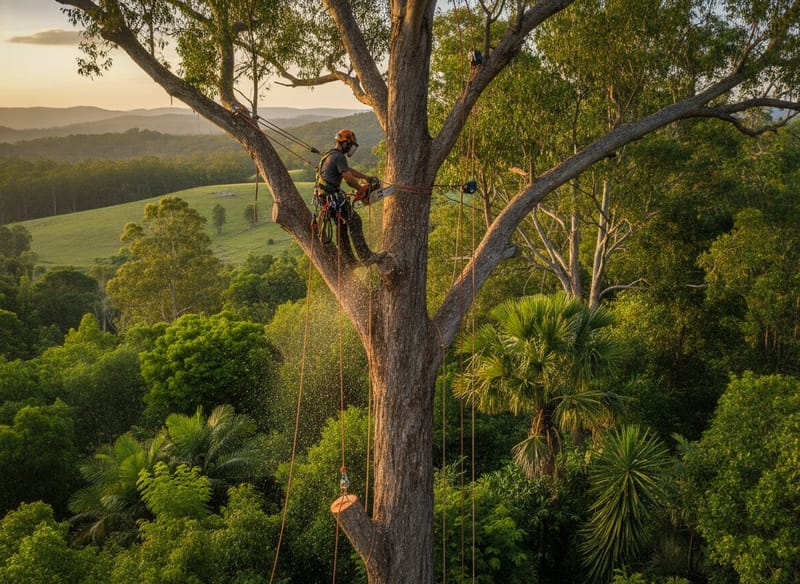
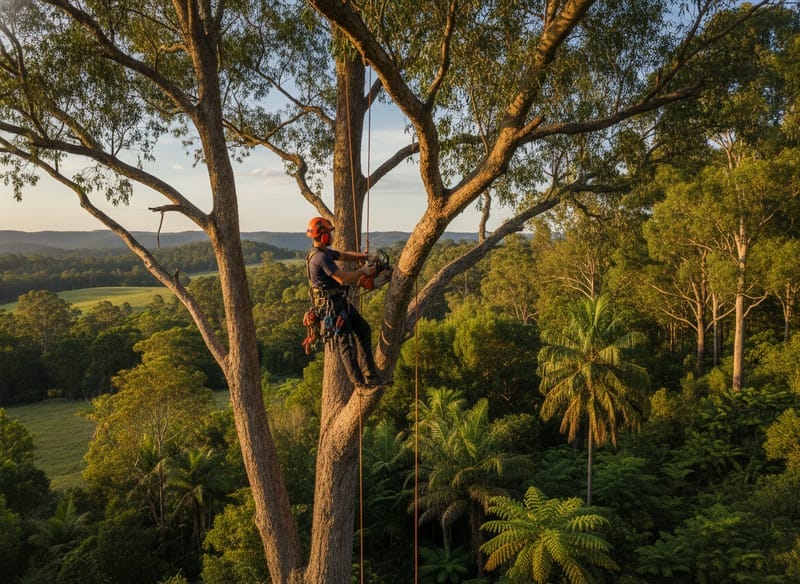
Ground-based and aerial diagnostics evaluating structural defects, biomechanical stress, fungal fruiting bodies, trunk hollows, and pest infestations (such as termite damage) to quantify failure likelihood and consequence.
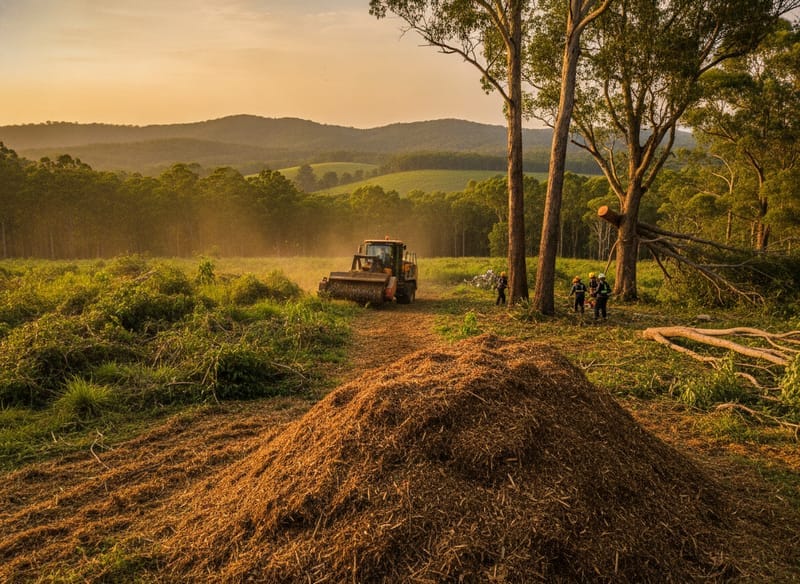
Authoritative documentation detailing irreversible structural decline, severe pathogen spread, or infrastructure conflict. Required when seeking approval to remove protected native vegetation or trees in mapped council overlays.
Detailed diagnostic reports following severe weather events or cyclonic winds. We document mechanical failure causes, baseline tree health prior to damage, and provide expert assessments for insurance claims or emergency recovery works.
Formal record-keeping documentation under the ex-Tropical Cyclone Koji disaster clearing exemption (active to January 2027), providing photographic evidence and risk logs justifying emergency vegetation clearance to maintain infrastructure and safety.
Booking an arborist report begins with a direct review of your property plans, council requests, and mapped site overlays. We establish the exact purpose of the assessment—whether it is a pre-purchase review, an extension application, or storm hazard mitigation.
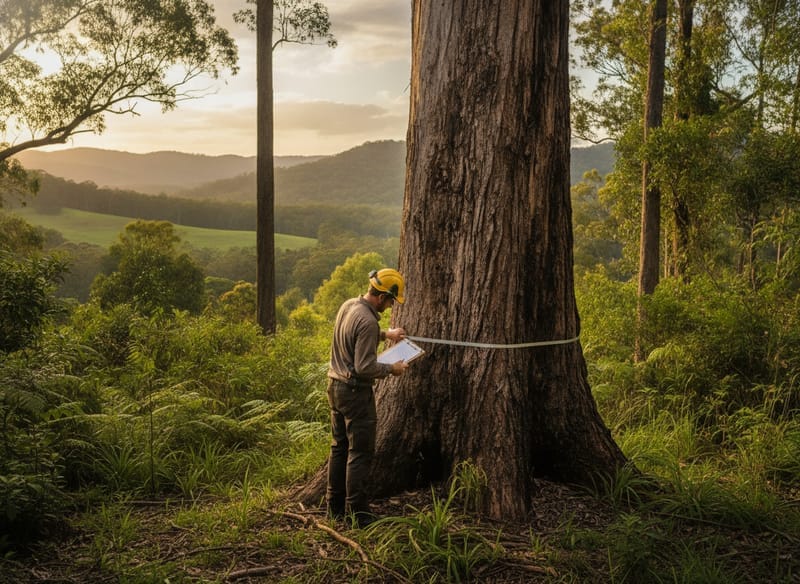
Next, our consulting arborist attends your Mount Pleasant property to execute a hands-on field assessment. We record precise biometric data for each subject tree, including Diameter at Breast Height (DBH), canopy spread, height, vigour, and structural defects. We map the site coordinates and inspect surrounding infrastructure, retaining walls, and underground services.
Using standard formulas under AS4970, we calculate the Tree Protection Zone (TPZ) and Structural Root Zone (SRZ) for every retained tree, overlaying these measurements directly onto your site layout or architectural blueprints. We assess potential encroachments caused by footings, driveways, or services.
Finally, we author your comprehensive, high-resolution PDF report complete with photographic evidence, SULE ratings, risk mitigation schedules, and stamped CAD-ready tree protection diagrams. We provide direct follow-up support to answer questions from certifiers, project engineers, or Council planning officers until your application is finalised.
Every assessment is prepared and signed by an AQF Level 5 Diploma qualified consulting arborist. This level of qualification is mandatory for formal submissions to the Mackay Regional Council, building certifiers, and insurance underwriters. Our reporting strictly adheres to AS4970-2009 (Protection of Trees on Development Sites) and AS4373-2007 (Pruning of Amenity Trees).
We maintain full public liability cover, comprehensive WorkCover, and professional indemnity insurance specifically structured for arborist consultancy. When aerial canopy inspections or elevated root crown explorations are required, our arborists hold current Working at Heights (RIIWHS204D) and EWP certifications. We ensure that every finding is scientifically validated, defensible in planning tribunals, and aligned with the Queensland Vegetation Management Act 1999.
Mount Pleasant presents unique environmental dynamics that influence tree stability and planning controls. Properties situated along the undulating slopes near Malcomson Street and the elevated ridge lines experience intense wind loads during monsoonal storm bursts. When combined with the high rainfall that saturates the clay loam soils between November and April, large trees like African Mahogany, Poinciana, and backyard Mango trees can experience severe root plate destabilisation.
Furthermore, planning applications in Mount Pleasant, Beaconsfield, and Glenella must navigate the Mackay Region Planning Scheme 2017 biodiversity and environmental significance overlays. Where lots border drainage corridors or remnant vegetation pockets, the Vegetation Management Act 1999 may also apply. In the wake of ex-Tropical Cyclone Koji, which caused widespread canopy failure across the Pioneer catchment, property owners operating under the state disaster clearing exemption (valid through January 2027) still require diligent photographic documentation and arboricultural justification to avoid future compliance disputes.
Once your report is delivered and site works commence, maintaining tree protection zones is vital. Ensure that protective chain-wire fencing and root-zone mulch beds remain undisturbed throughout the construction lifecycle. Never allow concrete washouts, fuel storage, or heavy plant access within the calculated TPZ radius. For mature specimens retained on residential blocks, schedule follow-up health assessments every 12 to 24 months, particularly before the start of the summer wet season. Should you observe canopy dieback, fungal fruiting bodies at the root collar, or soil heaving after significant rain events, contact our consulting arborists to re-evaluate structural stability.
Arborist report pricing depends on tree numbers, site complexity, and the report type requested.
We offer upfront, transparent pricing for all consulting arborist reports.
Providing AQF Level 5 arborist reports across Mount Pleasant and the wider region:
Contact our consulting arborists today to schedule a site inspection.
Book an Assessment