Rapid Property Protection
Removing fallen trees from structures prevents further water ingress and structural collapse.
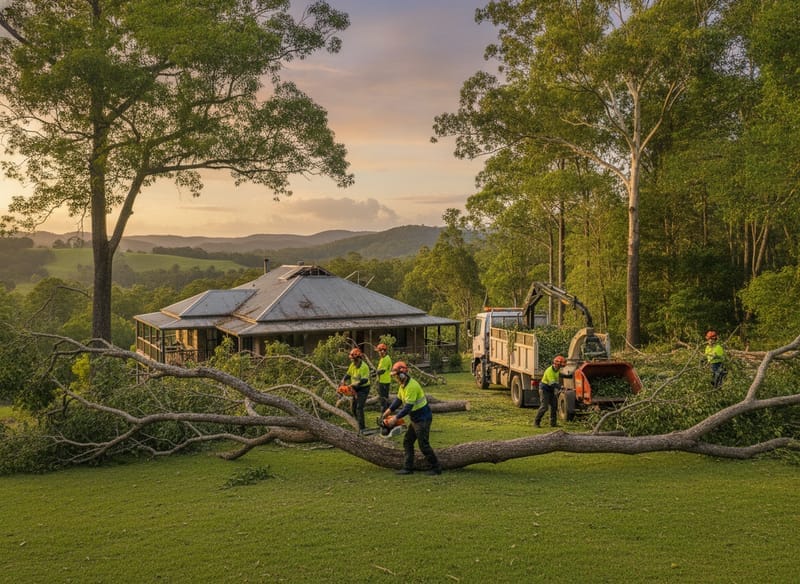
We make safe and remove fallen and dangerous trees that threaten your home, vehicle, or access roads following severe weather in Walkerston.
Storm and fallen trees handled across Walkerston and the Pioneer Valley.
Our emergency response service is focused on clearing structural hazards, fallen timber, and imminently dangerous trees.
During the monsoonal wet season, Walkerston's soil can turn incredibly soft. When combined with severe storm winds, this causes mature trees with huge canopies to fail at the roots, making emergency structural clearing a critical need.
Removing fallen trees from structures prevents further water ingress and structural collapse.
Clearing blocked driveways and roads ensures emergency services and residents can move freely.
Dismantling loaded branches safely eliminates the risk of sudden, unpredictable spring-back movements.
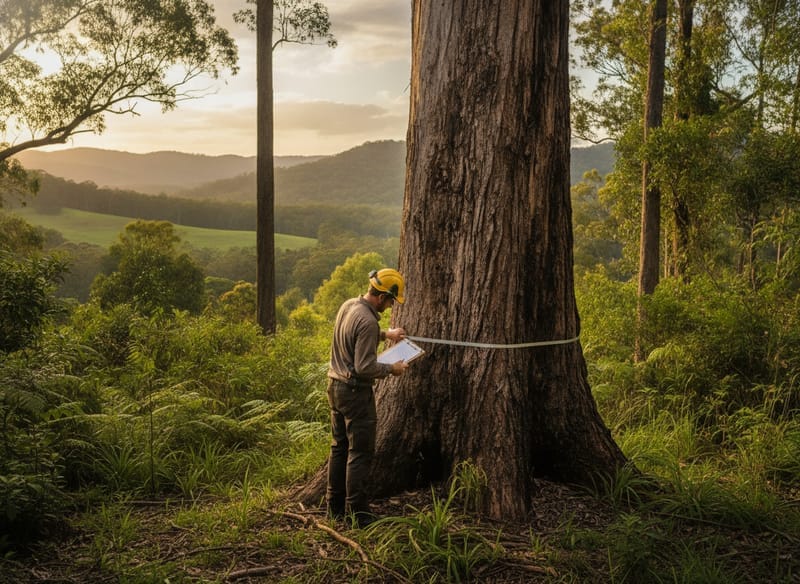
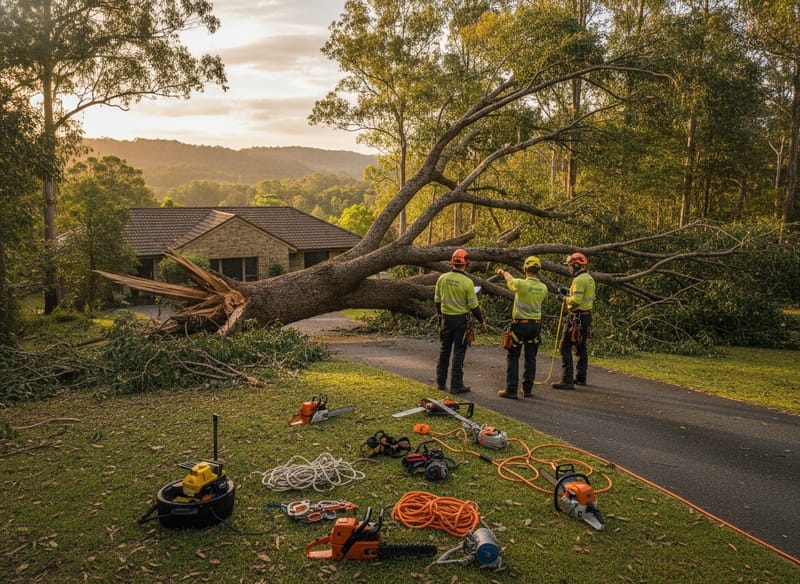
We inspect the fallen tree, checking for structural load, powerlines, and safety risks.
We formulate a fast, safe plan to dismantle the tree using advanced rigging or EWPs.
Our team executes precise cuts to relieve tension and clear the danger step-by-step.
We chip the branches and clear access paths, securing your property.
When severe tropical weather strikes the Pioneer Valley, dangerous tree failures demand action. Our dedicated Emergency Tree Removal Walkerston crew is on standby to secure compromised properties, clear access routes, and remove hazardous timber. Whether a massive branch has crushed a carport on an established residential block or an entire tree has uprooted across an acreage driveway, we deploy the heavy equipment and technical expertise required to resolve high-risk situations safely. Walkerston properties present unique challenges during extreme weather events. The combination of mature canopy trees—such as poincianas, heavy backyard mangoes, and expansive raintrees—with saturated alluvial soils frequently leads to catastrophic structural failures. In the wake of major weather systems like ex-Tropical Cyclone Koji, delayed response times can lead to secondary structural damage, water ingress, and severe safety hazards. Our team mobilises rapidly across Walkerston, Marian, and surrounding Mackay localities to restore site safety with precision.
Storm-damaged timber behaves unpredictably. When a large tree or heavy limb splits, falls, or hangs suspended in a canopy, internal mechanical forces create extreme tension and compression. Attempting to cut storm timber without professional training often triggers violent energy releases—known as spring poles or barber-chair splits—which can cause fatal injuries or crush nearby structures. DIY chainsaw operation on compromised root plates or storm-tangled limbs is exceptionally hazardous. Unqualified contractors frequently exacerbate the danger by dropping unbalanced loads onto roofs, damaging underground utility lines, or leaving partially cracked branches hung up overhead. In contrast, our qualified AQF Level 3 climbing arborists apply controlled dismantling techniques and engineered rigging systems. We de-tension compressed wood incrementally, anchor suspended limbs with dynamic rigging lines, and execute strategic target cuts in alignment with AS4373 (Pruning of Amenity Trees). This calculated approach neutralises immediate threats without creating collateral damage to your home, shed, or boundary fencing.
Every emergency removal requires specialised machinery, advanced rigging physics, and certified cutting protocols to safely extract hazardous trees from tight residential and rural settings.
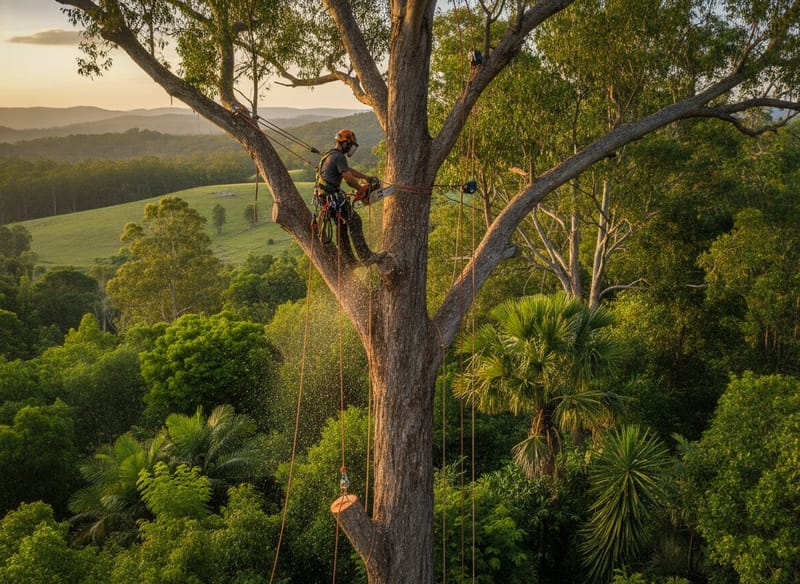
We utilize high-tensile arborist rigging ropes, friction bollards, and redirect pulleys to systematically dismantle limbs held under extreme wind-load tension. Trunks and heavy branches are stabilized prior to cutting, preventing sudden kickback or roll-over on sloping ground and saturated turf.
When a tree has fallen directly onto a dwelling, shed, or vehicle, we deploy mobile cranes to sling and hoist massive log sections vertically away from the structure. This eliminates secondary impact forces and protects the underlying building envelope from further structural failure.
For structurally compromised trees that are unsafe to climb, we utilize narrow-access tracked spider lifts and elevated work platforms (EWPs). This allows our arborists to access storm-damaged canopies up to 26 metres without placing climber weight on fractured anchor points.
Saturated soils cause whole-tree root failures where root plates remain under significant spring tension. We secure root balls with ground anchors and winch systems before severing the stem, preventing the root plate from snapping violently back into its hole.
Our commercial-grade wood chippers and high-sided tipper trucks process dense storm debris rapidly on site. Heavy timber is bucked using heavy-duty ground saws (including Stihl MS500i and MS461 units) and cleared using compact mini-loaders to quickly reopen blocked driveways and access roads.
From the moment you contact our emergency dispatch, our team initiates a structured, five-stage protocol designed to stabilise your property rapidly and efficiently. - Stage 1: Urgent Triage and Dispatch We evaluate site urgency over the phone—prioritising structural impacts, blocked access, and live hazard zones. Our Walkerston emergency team typically arrives on site quickly during standard operations, fully equipped for action. - Stage 2: Comprehensive Risk and Structural Assessment Upon arrival, our AQF Level 5 consulting arborist or lead climber assesses electrical clearances, wind loading, tension zones, structural integrity, and surrounding assets to formulate a controlled make-safe plan. - Stage 3: Make-Safe Operations We secure compromised limbs, remove direct weight from damaged buildings, and eliminate immediate fall hazards using rigging, winches, or crane assistance to neutralise active danger to residents. - Stage 4: Sectional Dismantling and Site Processing Once the site is stable, we systematically dismantle remaining timber in manageable sections, feed brush into our high-capacity chippers, and clear heavy wood from driveways and turf using mini-loaders. - Stage 5: Insurance Documentation and Clean-up We provide high-resolution photo documentation, written arborist make-safe reports, and itemised invoicing formatted specifically for major insurance claims, leaving your property tidy, clear, and fully secure.
Safety and regulatory compliance underpin every emergency job we undertake. Our field personnel hold formal AQF Level 3 in Arboriculture credentials alongside specialized certifications in Chainsaw Tree Felling, Working at Heights (RIIWHS204D), and First Aid (HLTAID011). We maintain comprehensive public liability cover and full WorkCover Queensland insurance for all crew members. All works adhere strictly to AS4373 (Pruning of Amenity Trees) and safety guidelines. Under the Mackay Region Planning Scheme 2017 and the active state disaster clearing exemption following ex-Tropical Cyclone Koji (effective to 13 January 2027 across the Mackay Disaster District), landholders are permitted to clear trees posing an immediate risk to life or property without prior council approvals. We ensure complete photo records and written justification are captured to satisfy all local council and insurance compliance requirements.
Walkerston occupies a distinct geographic transition between Mackay's coastal plain and the broader Pioneer Valley. The township features a mix of older residential quarter-acre blocks, newer suburban estates, and large semi-rural acreage along the Peak Downs Highway corridor. These properties are populated by heavy tropical shade trees, including poinciana (*Delonix regia*), mango (*Mangifera indica*), large weeping figs, and spreading raintrees (*Samanea saman*).
During our tropical wet season from November to April, monsoonal deluges saturate the heavy local clay and alluvial soils. When severe storm cells or cyclonic gusts sweep through the valley, the saturated ground loses friction around root zones. Heavy-canopied species such as forest red gums (*Eucalyptus tereticornis*) and sprawling poincianas are prone to complete root plate uprooting or major lateral limb tearing. When local homeowners need dependable Emergency Tree Removal Walkerston, our familiarity with local soil profiles, tight side access in older township streets, and acreage machinery access ensures an effective and safe resolution.
Once the emergency has passed and the hazardous timber is removed, proactive property management is essential to prevent future structural tree failures. High-wind events often cause unseen internal cracks and micro-fractures in surrounding trees that did not fully collapse.
We recommend scheduling an AQF Level 5 tree risk assessment before the next wet season. Our arborists can identify weak branch unions, internal decay pockets, and heavy over-extended limbs that require formative pruning or weight reduction under AS4373 guidelines. Additionally, applying the fresh organic wood mulch generated during your emergency removal around remaining root zones will help retain soil structure and nourish stressed root systems.
Emergency tree clearing costs reflect the danger level, machinery needed, and job complexity.
We provide clear, upfront cost structures before commencing high-risk emergency work so you can seek insurance coverage.
We handle emergency storm and fallen trees throughout Walkerston and the surrounding Pioneer Valley.
Get professional assistance to safely dismantle dangerous or fallen trees on your property.
Call 0495 090 664 Now